There’s really no mindf*ck like an SEO mindf*ck, amiright?
Because unfortunately, I can confirm that if it’s not one thing with SEO – it really is another.
(Especially when you’re flooded with Tech Bro Talk and giant to-do lists that confuse you more than they help you)
But here’s what – apparently – they don’t tell you about SEO, your website, and using it to book more clients:
It really can be as simple as good, helpful content, thoughtfully created for the right people.
And copywriting is the thing that ties it all together.
🎤 PS – want to listen instead of read? This post pairs perfectly with my episode on The Coffee & SEO Podcast, hosted by Taylor of Aligned SEO!
Copywriting supports your SEO goals – and I’ve got receipts in the form of ranking factors.
Good copy does, in fact, improve your SEO. It’s not only the context for any keywords you use, it’s also what makes people actually spend time on and use your website.
Beyond keywords, copy directly impacts several of Google’s “ranking factors,” AKA the things Google takes into account when deciding how to rank pages (and which websites to deliver for which searches).
Dwell Time/Time On Page
Tech bros would call the amount of time someone spends on your website their “dwell time,” and both of us would tell you it’s probably part of what helps your SEO. Longer time = more interesting content = more likely to be ranked higher by Google.
Keyword Optimization
Are you using the *right* keywords on your page (ones your audience is searching and you can reasonably rank for)? Are you using them the right amount of times? Are they in the right places (on your page copy, in your H1 heading, and in your page title/description)?
^ you need all of those ingredients to set up your SEO correctly, whether you DIY them, get them from your SEO expert, your SEO-informed website designer, or your friendly neighborhood SEO copywriter.
🏠 CLIENT EXAMPLE: Mckayla did her own keyword research because she’s quite literally an SEO expert, but I was in charge of pulling all of her chosen keywords into her sales page copy, making sure they were in the right places, and used the right number of times.
Internal Links
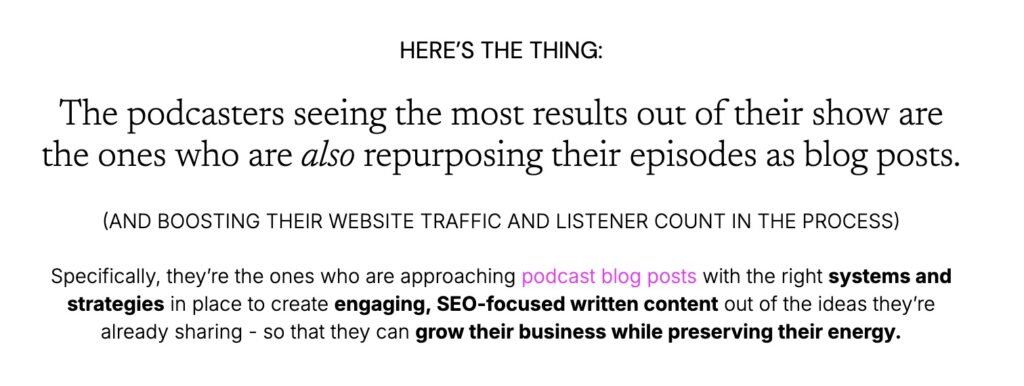
Links from one page (or blog post) of your website to another are a ranking factor – but more than that, they help guide the way people move through your website. It’s basically your way of being able to offer up more content in a casual, chill way – and let your readers decide if they want to explore.
Internal linking/linking in general are also my favorite way to get ideas for content – because you can think about writing and content from the lens of what would be helpful to have a shareable link for (one of my best tips for planning blog content topics).
For example, I wrote this post about Showit & SEO entirely to have a link to share when it gets talked about on Threads (which, in my neck of the algorithm is like…every 2 seconds) – conveniently, it was *also* a topic that I was able to find good keywords for, but more than that, it’s super shareable reference content that I can share regularly and actually help people with.
🏠 CLIENT EXAMPLE: Stalk Casey’s project for one of my favorite ways to use internal linking in copywriting projects – as I researched her SEO keywords, I also pulled together an SEO-based blog strategy for her next few months, and created a section for how & where to feature certain blog posts across her website to make it easier for her people to see all of her work.
SEO is part of what gets people to your website, but copy helps them decide what to do when they get there.
Are they gonna get the info they need and bounce? Are they gonna laugh while they read, or smile, or maybe cry if the mood calls for it – and realize you’re someone to hang around with, because you get it *and* know what to do about it?
Unless your business model requires tens of thousands of pageviews per month because you want ad revenue from blogging – your website traffic means little to nothing if you’re not making sales or booking clients from it.
And all of that is your copy’s literal job.
Your copy is in charge of:
- Warming people up and getting them familiar with you, so you start becoming someone trusted that they know can help with their problem
- Showcasing what you do and the results you can help them get, making the case that not only are you trustworthy in general – you’re worth their money
- Helping people decide which of your products/services/offers fits them, so they can navigate your website on their own and make decisions on their own time instead of feeling pressured and rushed
- Answering questions and handling objections before they have them, so when they do reach out (or buy), it’s a confident decision that they’re committed to making
So yes, copywriting does help your SEO – but more importantly, it builds your community, inquiries, and brand world.
Website-centric (and yes, SEO-friendly) content is more future proof and less algorithm-vulnerable than socials.
Welcome to what I’m going to fondly refer to as a “trickle down” effect of content.
If your content marketing strategy is rooted in social media only, you’re subject to more algorithms – Instagram, Threads, Pinterest, Tiktok – and those algorithms decide who’s going to see your content (and for how long).
Google is *also* an algorithm, but as far as robots go – it’s a more chill, consistent one. Blog posts/website pages can circulate for about 2 years (and that’s *without* updates), while Pinterest pins get ~4 months, and Instagram posts get less than a day (source).
Blog posts and website pages are also editable, which means you can go back and evaluate/update them to be more helpful (and rank higher) as time passes, algorithms and information change, and you learn more – compared to social media posts, which you can’t *really* get recirculating in a big way (obviously, you can always create new content! So I’m not totally writing it off).
And of course, I wouldn’t be me if I didn’t also mention that you own your website, but you rent social media – and as someone who’s woken up to their business Instagram account shut down for quite literally no reason, I *promise* that having a website-centric content strategy will give you more peace of mind than a blue checkmark ever could.
Trickle-Down Content
Not *every* topic needs a long-form blog post (nor do I think all of my sleep-deprived Threads should be immortalized for longer than their average lifespan of 2 hours), but longer blog posts *can* give you content for dozens of shorter social media posts. For big topics that are going to require a lot of research & teaching, they’re *the* way to go (and *the* way to start, before you create a carousel or Reel).
Human content > robot content, every time.
No matter which algorithm games you’re opting into, the goal is to use them to find your people – and people will always be the ones you’re creating the content for. Algorithms – especially ones like Google – exist to help *actual humans* find content they’re interested in, and you’re an actual human helping actual humans in your business…
So it’s okay to write like it. I’d argue that it’s even better.
Stuck on how to make the robots happy while still sounding like you?
Relatable.
Most of my clients and students come to me with a sense of what goes on a website, basics of SEO, and definitely an understanding of their business and audience –
But without the time or inclination or skills to pull it all together into copy that actually makes people want to work with them, and makes Google happy, and still sounds like them.
Good news, because I can help with that –
>> Download the (free!) 20-minute messaging workshop to learn how to talk about what you do and make people want it, then…
>> Join Cook Your Copy to put it into action on your core website pages (and get unlimited support and guidance as you do it).