I’m not usually one to throw down, but when it comes to the fight for long form sales pages and why they work, I’m gonna need you to hold my earrings.
If you’re branching out into the world of “scalable offers” (AKA, one offer that helps many people, instead of a 1:1 service), your offer probably needs a long form sales page!
With all the ~noise~ about page length, user friendliness, best practices for conversions, and even how to yap about your offers in the first place, it’s easy to feel so conflicted that you just throw some words on a page and hope for the best.
But unfortunately, it’s also *far* too easy to miss out on sales like that.
As a copywriter who specializes in website and sales page conversions, I’m here to set the record straight about why long form sales pages work — when they’re done right.
Okay, I’ve calmed down now. I’ll take my earrings back, thanks.
What even is a sales page?
The simplest definition? A page on your website that sells a thing.
The more practical definition? A long form website page that sells an offer that’s…
- Scalable (one-to-many)
- Expensive to your target audience
- A decent amount of work for the buyer (like a group program, where they’ll have to put in effort to get the results)
As a copywriter, the ONLY reason I differentiate between a long form sales page and a page for a service, lower-cost product, etc., is because the structure and approach for this type of offer requires more detail, more planning, and more words.
I don’t care what you call your page as long as it’s well-written for your offer, but for reference — “short pages” are usually 500-1000 words, and most long form sales pages I write are 2,500+ words long.
And before you tell me that’s too long, no it’s not — as long as you’re not boring, repetitive, or adding irrelevant shit to fill the word count.
Long form sales pages perform better than short ones for certain types of offers.
The higher the “barrier to entry” is for your offer, the more words you’ll need to do it.
Shorter pages primarily work for offers where…
- It’s straightforward or easily explained.
- Your offer is low-cost or low-risk to the buyer.
- There’s minimal commitment involved.
Let’s talk about my hair for a second. I’ve had two babies (they’re technically full-ass kids now, but whatever), pregnancy forever changed the texture of my hair, and it’s annoying to me.
When I’m buying shampoo and conditioner, I need minimal convincing. They’re a need, I have approximately zero loyalty to brands, it’s not expensive, I already know what they do and how to use them, and they’re consumable (I’ll use it up in a few months and I can buy a different kind if I didn’t like it).
This is a low-cost, low-risk, low-barrier-to-entry offer.
It takes approximately ~2 words and a quick skim for me to pick my next haircare victim, because all I really care about is that it fights frizz and has 4-5-ish stars. Sold. Done. Next.
But if you were going to sell me on something like, say, a $500 hair dryer? I’m gonna need you to sell me harder, because you’re asking for WAY more money, I’m going to have to actually use it, and (in this case), I already have a semi-acceptable solution going.
It’s going to take more words for you to tell me…
- How to use it (or how you can help me learn it, once I have it)
- Why it’s better than what I’ve been doing
- How long it’ll last me (I am NOT giving you $500 for a POS that breaks down after a year)
- What else it can do for me
I’m well into adulthood and only recently had to replace my first-ever CHI flatiron (the same one I used to straighten my unfortunate side bangs in middle school), so a hot tool is a COMMITMENT that I don’t take lightly.
The data agrees with me: longer is better, where there’s more objections, risk, or money involved.
Why do long form sales pages work?
Long form sales pages convert well because they provide a continuous plotline, with context. When done right, they’re written to parallel the reader’s journey along the stages of awareness, and move them from…
- Knowing they have a problem or need a solution
- Knowing which solution they want
- Buying the solution in front of them
ALL ON ONE PAGE.
Increased Space For Objection-Handling
Short pages simply can’t handle every doubt, objection, or question — which is only okay when your offer and audience lend themselves to minimal doubts or questions (low-stakes offers, remember?).
High-stakes offers are going to require MUCH more anticipation of your readers’ needs, and will naturally be longer as you address them — which is why they tend to convert 220% better than short pages.
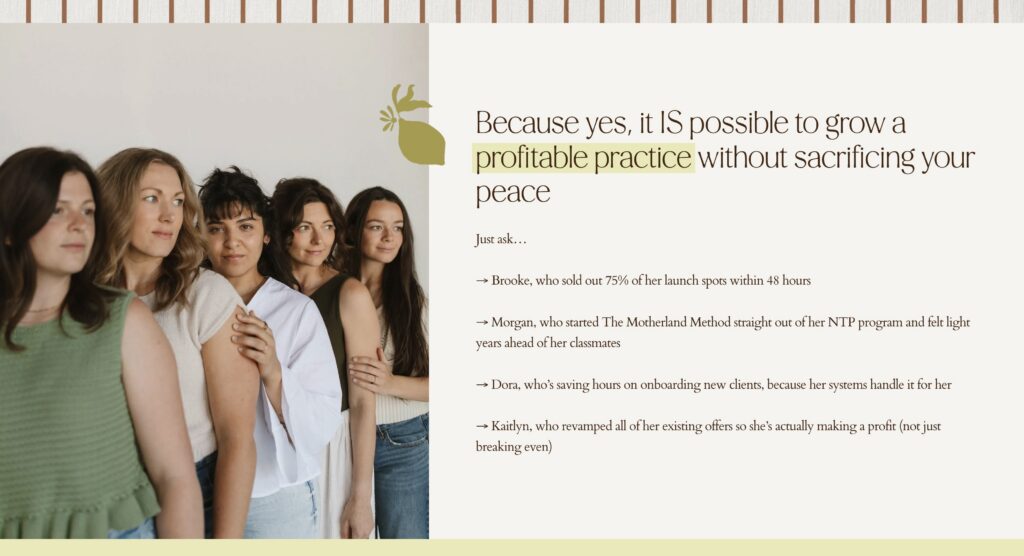
More Room For Social Proof
Adopting a long form sales page format also gives you more room for social proof, mini case studies, and client quotes — like this section from Kinsey’s Motherland Method mentorship program:
Improved ~Self-Selection~
Self-selection (how your page helps buyers weed themselves out if it’s a bad fit) is CRUCIAL for all offers. Even if your offer is a self-paced course, we do not push sales at all, but especially not towards people who aren’t the ideal audience for it.
That’s how you end up with disappointed customers, a bad reputation, and clawed-back transactions.
This is especially important for offers like group programs and collaborative memberships. I’m a firm believer that your offer only sells as well as it delivers on a promise — you cannot out-market a shitty customer experience. If your offer is going to require buyer participation, the stakes for self-selection are even higher.
More Emotional Investment
The more thorough and conversational your sales page is, the more readers will become connected to you and the offer itself as they read. This is what takes offers from “eh, I guess I could” to “Holy shit, I need this now.”
Better SEO*
*Take this with a grain of salt, because you can’t just add random thoughts to your page “for SEO” — but Google views pages less than 300 words as “thin content” and is less likely to send people to them.
You can still create an engaging, skimmer-friendly experience with long form sales copy.
Not every reader on your page will scour through every single word — in fact, most won’t read the entire thing.
As a copywriter, that would bother me… if I didn’t know that trend and prepare for it, so I can focus on making the sale.
The trick is to use headings, bullet-pointed lists, and other design layouts to keep the long form sales page copy from feeling too long. People buy best when the decision feels easy — so making sure they can find what they need is non-negotiable.
Want some help with your own long form sales page?
- Grab the Skip The Stuck sales page copy template and write your entire sales page in one sitting! It’ll help you write a long form sales page that actually gets read, answers questions before people can even ask, and converts readers into confident buyers
- Hire me to write your sales page for you, so you can be 100% sure that it hits all the right notes for each and every type of buyer that lands on it