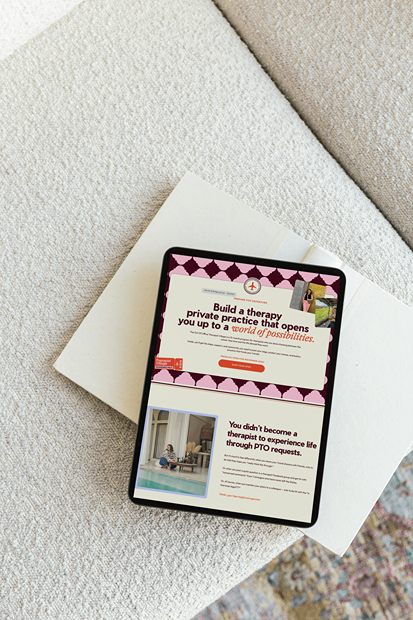
If you have a website, you have website copy (the words on the page that guide and inform your visitors). SO many people don’t realize that their website designer isn’t responsible for website copy (unless they explicitly say so in their proposal) – so let’s talk about how to write website copy that actually works, so your website actually gets you more clients.
Your Website Copy Affects Your Bottom Line
Your website design’s job is to catch attention and interest, keeping people there long enough to read the writing.
Your website copy, on the other hand? It’s actually carrying the team – because not only does copywriting inspire the action you want your readers to take (whether it’s buying, inquiring, booking, or subscribing), it informs the website design itself.
Good website copy:
- Provides everything the reader wants to know (and what they *need* to know, whether or not they’re aware of it)
- Is tailored to the target audience’s level of knowledge
- Creates a sense of need and excitement in the reader to know more/sign up/take the desired action
- Helps give your brand dimension (brand voice and copy are part of your overall brand!)
- Saves you time, because you’re no longer making a hard sell to every lead that comes through your inbox – they’re already much more ready to buy
Here’s how to write website copy that checks off the entire list:
Website Copy Tip #1: Get to Know Your Audience
Before you can write good website copy, you need to know exactly who you’re writing for. Get clear on your target audience’s needs, desires, and pain points – then touch on all of it in your writing.
Here’s what you’ll need to know:
- What problem does your target audience have (that they’ll need your help with)?
- How does that problem affect their everyday lives?
- How much do they know about the problem and how to solve it (what stage of awareness are they in)?
- What kind of reassurance or pep-talking will they need to actually take action?
I recommend creating a profile of your target audience so you can keep them in mind when you’re writing – bonus points for finding a photo to represent them! Humans buy from humans, so connect to your audience as much as *humanly* possible.

Website Copy Tip #2: Write Like You Talk
Specifically, how you speak to potential clients and leads when they reach out. Is your voice warm? Joking? Reassuring? Friendly? Professional?
Being as accurate and authentic as you can is THE best way to write website copy.
My favorite tips for how to write website copy that actually sounds human:
- Don’t use ChatGPT or AI without heavy edits. AI is great for coming up with ideas and getting you unstuck, but the tone will always be lacking in comparison to a real conversation – so DO NOT PASS GO without editing.
- Use your actual voice. Dictate your copy with a Chrome plugin like this one, ask a friend to interview you on a recorded Zoom (then go back and type), or send yourself voice notes.
- Use bold letters, italicization, ALL CAPS, and other accents to make your writing come alive before publishing.
Website Copy Tip #3: Anticipate Needs (& Meet Them)
No matter how thorough your writing is, your readers ARE going to have questions – and many of them won’t take the time to get reach out to you to get them answered (why would they, when they’re one back-button-click away from finding another website to read in their Google search history?).
This is the ONE thing you need to know when it comes to how to write website copy that actually works and brings you clients.
Your website MUST anticipate what questions your readers will have and answer them 1) thoroughly, and 2) repeatedly.
Here’s how to do it:
- Brain dump all of the common questions you get from leads, discovery calls, and the beginning of your work with your clients.
- Write the answers into your website copy in the most natural way possible (example below). I recommend against the question-answer format (“Why should I buy this course?” “LIST OF REASONS”) – we’re here to keep it interesting, not robotic.
- For really important questions (pricing, timeline, etc) – make sure this information is prominent on your page when designing.
- As you’re writing, ask yourself what questions your reader likely has about that section based on their stage of awareness – and add or pare back as needed.
- Mix in some informational sections with bullet points or lists for the skimmers.
- Don’t save it all for the FAQ’s. My general rule of thumb when writing FAQs no more than 4-5 FAQ’s per service (or even for the whole website) – we want your readers to find answers exactly when they need them, not to get hit with a whole list of information at the end.
Website Copy Tip #4: Keep Your Copy as Clear as Possible
Clear = kind, AND clear = conversions.
Your readers should never have to guess what you’re offering or how to work with you. Keep your language fairly simple and straightforward (unless your target audience is super technical or well-versed in what you’re serving up).
For example: If you’re a therapist specializing in a really specific type of therapy or way of practicing, the words you would use to describe what you do are NOT the same as how your client would describe their needs. Frame things in the language of your reader so they have to do as little work as possible to understand your writing and offer.
Website Copy #5: Be Liberal with CTAs
Your website copy should always guide visitors toward the next step, and that’s where clear, compelling calls to action (CTAs) come into play. Think of CTAs as little signs that tell your audience exactly where to go and what to do next, whether it’s booking a consultation, signing up for your newsletter, or downloading a free resource.
The key to an effective CTA is to make it specific and action-oriented. Vague phrases like “Learn more” or “Get started” can be easily overlooked because they don’t inspire immediate action. Instead, use strong, directive language that clearly communicates the benefit of taking that next step. For example, “Book your free consultation” or “Download your guide” are direct and tell your audience exactly what they’ll gain by clicking.
On placement: Don’t wait until the very end of a page to present a CTA—strategically place them throughout your site where it makes sense for the reader to take action. Think about moments in the copy where they might be convinced or inspired, and place a CTA right there to keep the momentum going.
Website Copy Tip #6: Get to the Damn Point
Someone reading your core website pages isn’t there to read a novel. While some pages (like long-form sales pages) are intentionally more lengthy, fluff is NEVER necessary.
If you find yourself wanting to over-explain a concept or write more, here’s what to do:
- Ask yourself why you want to write more.Are you unsure that you’re being clear? Ask a friend (or even ChatGPT) to proofread and see if they can follow your writing.
- Do you just have more to say? Relatable, but save it for social media/your newsletter/a blog where the content is *expected* to be either longer or less focused.
- Evaluate your offer itself. If it’s that hard to explain, it’ll be hard to sell – and hard for your clients to get excited about.
Website Copy #7: Phone a Friend
A fresh perspective is one of THE most valuable tools when it comes to refining your website copy. After you’ve written and edited your content, have someone who isn’t familiar with your industry read through it. Ideally, this person should be a blank slate—someone without much knowledge about your services or what you do.
WHY THIS WORKS: Potential clients who are visiting your site for the first time are often in the same position. If your copy isn’t clear to an outsider, it’s likely not clear to your audience either. Having someone with a fresh set of eyes go through your website will highlight any confusing or overly complex parts of your messaging.
This outsider can help pinpoint where you’re using too much jargon, missing important details, or creating unnecessary confusion. When they get stuck, ask them why. If they’re unclear about a service or process, that’s a signal to revisit and clarify that section of your copy.
- What’s the benefit of (my offer)? – Can they easily explain the benefit of your service or product? If they struggle, it may mean the value isn’t coming across clearly enough.
- What action would you take next after reading this? – Does your copy naturally guide them toward a specific action, like booking a consultation or contacting you? If not, your CTAs might need to be clearer or more compelling.
- Did anything confuse you or feel unclear? – Are there any points in the copy where they felt lost? Clear is KIND, remember?
- Who do you think this service is for? – Can they identify your target audience from the copy? This will help determine whether your messaging resonates with the right people.
- What stood out to you the most? – What parts of the copy are memorable or impactful?
Need help getting unstuck with your website copy?
>> Grab a website copywriting template that’ll guide you through writing your site and organizing your copy – from top to bottom – in a way that works.
>> Check out my done-with-you website copywriting program, a 6-week experience for writing your own copy in a way that speaks to your ideal clients, gets your website found, *and* feels true to you.